

This story was published in Volume 1, Issue 1
For a quarter-century, Virgin, Utah has served as the Mecca of the mountain biking world.
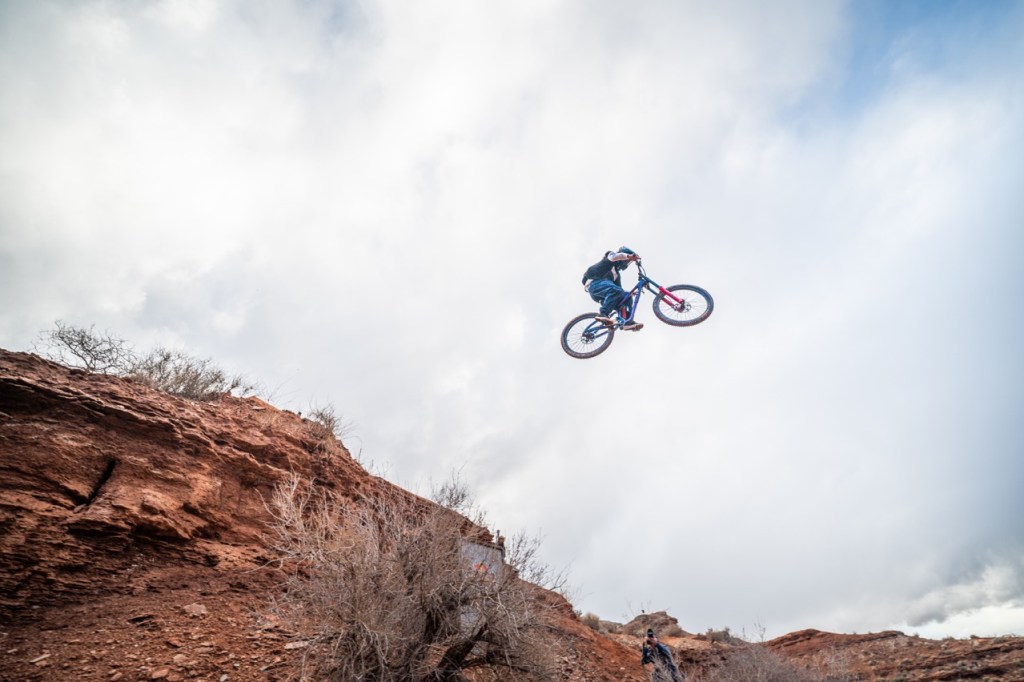
Each October, devout fans make the annual pilgrimage to the 670-person town bordering Zion National Park to witness some of the sport’s best athletes push boundaries and break records. Thousands more tune in to the online broadcast.
In one week, the mountain is transformed from a blank canvas into each rider’s own masterpiece. Since its inception in 2001, the event has brought colossal attention to the sport, inspiring new riders and fans across the globe.
Ten days before the competition, the riders stand at the bottom of a jagged mountain, scoping the gnarliest route down. In the following days, dig teams work tirelessly to transform the landscape into some of the hardest riding in the world.
This year, they were faced with the challenge of weather. Rain and mud made it not only difficult to build, but even harder to ride. Two athletes walked away with gold medals. Three left on an airlift.
Janelle Soukup is currently enrolled as a full-time student at the University of Colorado Denver, where she is studying mechanical engineering. While at Rampage, she celebrated her 20th birthday surrounded by massive drops and lots of red dirt. As a rookie and the youngest rider, she felt the pressure coming in.
“You see all the girls drop in front of you, and they’re so composed and so locked in,” Soukup said. “I was like, ‘Holy crap, I don’t know what I’m doing up here.’”

With the debut of Women’s Rampage in 2024, there was immense excitement to see the progression that happened in one year. The women did not disappoint, throwing down crazy lines, with some adding in tricks and flips.
At the podium ceremony, signs were out. Kaylee Taylor traveled from Bend, Oregon, to show her support, holding a sign that read, “Girls just want to send big.”


Back-to-back winner Robin Goomes threw down two backflips among a long list of tricks to give her the win over Hannah Bergemann by 0.17 points. Finishing out the podium was Georgia Astle. Goomes walked away with $100,000 and a 2025 Ford Raptor Ranger.

Rampage is a brutal event that is not forgiving. Mistakes can mean dire consequences. Despite dislocating her elbow in practice two days prior, Cami Nogueira dominated her line for a well-earned fourth place. The strength and determination to not let her injury keep her away from competing resulted in her walking away with the toughness award.

After missing last year due to a torn Achilles tendon, Bergemann did not let Goomes take an easy win. She threw down her own series of suicide no-handers and a massive backflip at the bottom of her run.

The men threw down. They tried a wide range of tricks toward the bottom of the venue with massive drops in the range of 40 to 70 feet, canyon gaps and gnarly ridge lines. Although the men’s competition started in 2001, every year the caliber of riding increases.
Aiden Parish made a 67-foot diagonal step-down that he sent for 92-feet in practice. Two days later, he ended the step-down a little short, getting launched off his bike and breaking his femur and helmet.
Two more injuries came on competition day. While Adolf Silva attempted a double backflip on his second run, he under-rotated and flew over the handlebars, ragdolling down the landing. He was quickly airlifted to St. George Regional Hospital, where he was diagnosed with a spinal injury that left him with no feeling from the chest down.
Just minutes after the competition resumed, Emil Johansson crashed on the opening trick of his run. He was thrown off a narrow ridgeline towards a sheer cliff. He stopped short but severely dislocated his hip, requiring a technical extraction and pausing the competition for over an hour.
